Employee voices have become the strongest distribution channel a B2B brand can have. Every post, comment, or share by your teammates extends your company’s visibility and builds the kind of social proof that no ad budget can replicate.
But here’s the catch: Most companies still treat LinkedIn employee advocacy as an informal side project – “share this link if you can.”
The result? Inconsistent participation, buried posts, and missed opportunities to connect with buyers, talent, and followers.
In this article, we’ll look at:
- Why teams struggle to maintain consistent LinkedIn employee engagement
- How to make advocacy natural and measurable
- And a real-world fix using LeadDelta Custom Engagement Feeds, designed to make sure you never miss a teammate’s LinkedIn post again.
How employee engagement improves company performance
Employee advocacy is more than a marketing lever, it’s a culture amplifier.
When people engage with and support each other publicly:
- Engagement drives retention: Employees who participate in advocacy feel more connected to company success.
- It strengthens employer brand: Prospective hires see real employee voices representing the company, not just polished brand statements.
- It builds community: Employees become part of ongoing professional conversations, learning from each other’s perspectives and industry insights.
So if the upside is that big… why do most advocacy programs fail to scale?
The real problems with LinkedIn employee engagement
Important posts get buried by the algorithm
LinkedIn’s feed is designed to show what’s “relevant,” not necessarily what’s most important for your team. That means your colleague’s post announcing a new customer win or job opening can disappear under a pile of unrelated updates.
The timing of engagement matters. Posts that receive early traction (within the first hour) get rewarded by the algorithm. Miss that window and you lose reach, social proof, and valuable buyer visibility.
Advocacy feels forced or transactional
When advocacy is treated like a checkbox (“Share this company post”), it feels inauthentic. Employees are hesitant to post or simply copy company content word-for-word. That lack of ownership kills authenticity and engagement.
No central visibility or coordination
Many teams try to coordinate engagement via Slack or email threads. But chasing links and reminders wastes time. People forget to act, comment late, or duplicate each other’s efforts. There’s no single place to see what’s happening across your team.
No measurable feedback loop
Without seeing what performs well- who’s engaging, what post types drive replies, which times work best, teams can’t improve. Over time, engagement fizzles out because no one knows what’s actually moving the needle.
The fix: Treat LinkedIn advocacy like an internal engine, not a guessing game
Successful companies don’t rely on reminders or Slack nudges. They build repeatable systems where visibility, coordination, and timing are all baked in.
That’s where LeadDelta Custom Engagement Feeds come in.
What is a Custom Engagement Feed (and why it matters)
A Custom Engagement Feed is a workspace-level view inside LeadDelta that aggregates posts from selected LinkedIn profiles.
Instead of relying on LinkedIn’s unpredictable algorithm, you get one organized, automatically updated feed showing every teammate’s latest post, who’s already engaged, and where you can add value.
How it works:
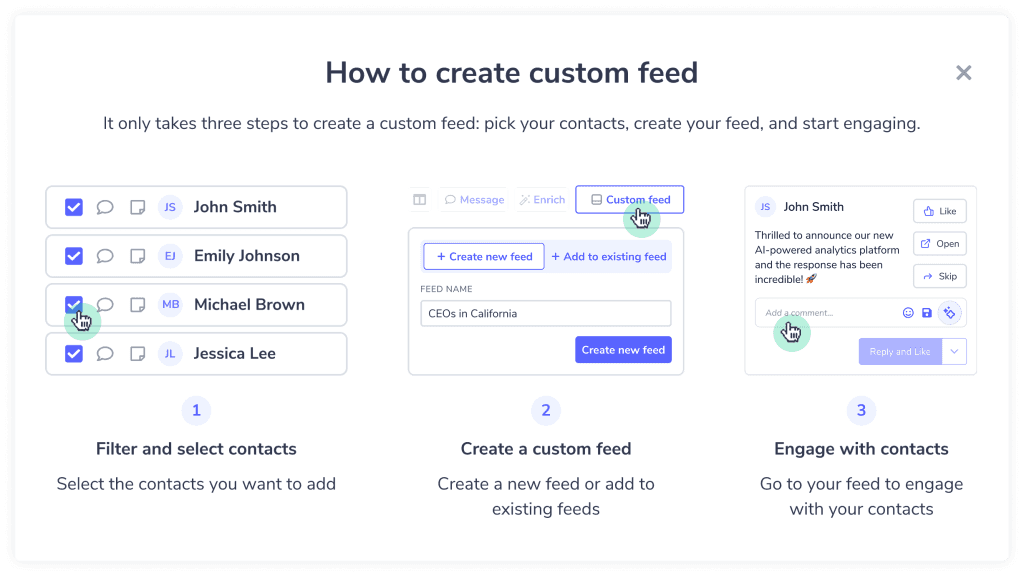
In five minutes, your team gets one simple habit: open the feed, engage, and stay visible.
👉 WATCH: Engage smarter with custom LinkedIn feeds
Why this approach works right now
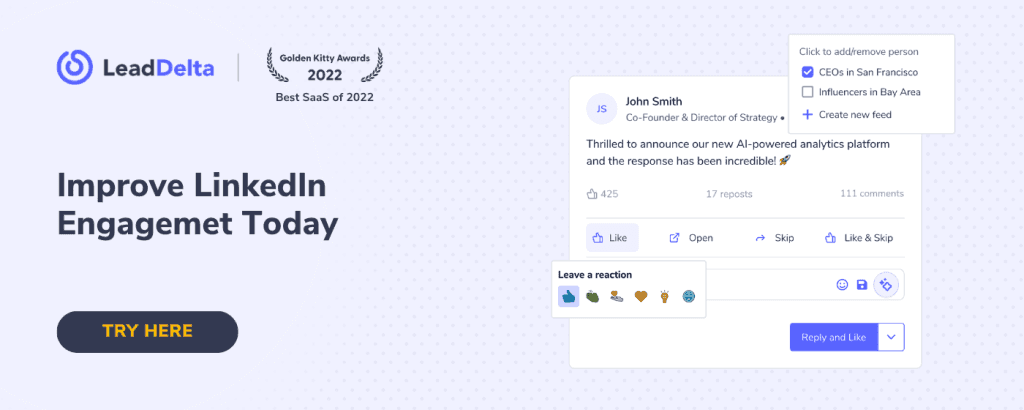
- Centralized visibility: No more scrolling through personal feeds hoping LinkedIn surfaces team content.
- Coordinated engagement: Avoid duplicate comments and add complementary takes for richer discussions.
- Faster first-hour traction: Early engagement signals relevance to the algorithm.
- Pipeline impact: Shared advocacy builds credibility with buyers who are researching you on LinkedIn.
Teams using this system consistently report higher post reach, stronger participation, and more demo conversations originating from comments and DMs.
Who uses it
- Sales & CS: Social selling, QBR stories, renewal wins, and warm touchpoints with target accounts.
- Marketing & Comms: Product launches, PR amplification, and coordinated employee advocacy.
- Talent & HR: Employer branding and hiring campaigns.
- Execs & Founders: Thought-leadership and company-vision posts.
Example results teams are seeing
Teams using LeadDelta Custom Feeds report:
- 2–3× more engagement on employee posts
- Consistent daily participation without reminders
- 20–40 % higher post visibility within their target buyer networks
- Increased inbound demo requests or candidate conversations from LinkedIn comments
The biggest win isn’t just numbers, it’s alignment.
Every team member can see what others are saying, engage strategically, and keep the brand message unified while staying authentic.
Building a culture of employee engagement on LinkedIn
Technology alone doesn’t fix advocacy, it enables a culture. Here’s how to make participation feel natural and rewarding:
Lead by example
When executives, founders, and managers post regularly and engage on others’ content, it sets the tone.
Leadership visibility is the most effective motivator for company-wide participation.
Clarify the “why”
Show employees what’s in it for them:
- Personal brand growth
- Networking opportunities
- Thought-leadership visibility
- Internal recognition
When they see LinkedIn as an investment in their careers, not just a brand obligation, participation skyrockets.
Train for authentic posting
Run short workshops on:
- How to write strong LinkedIn posts (hook → story → takeaway)
- How to comment meaningfully instead of “Nice post!”
- When to engage (timing, hashtags, tagging)
Encourage real experiences: customer lessons, product learnings, hiring stories, and behind-the-scenes moments.
Recognize and celebrate advocacy
Share analytics internally. Celebrate the employee whose post got 10 K impressions or generated a warm inbound lead. Small public recognition reinforces behavior better than any incentive.
Putting it all together
Let’s recap:
- Problem: LinkedIn’s algorithm hides important team posts, leading to missed engagement opportunities.
- Impact: Less distribution, weaker social proof, and missed buyer conversations.
- Solution: Use LeadDelta Custom Engagement Feeds to centralize visibility, coordinate engagement, and build authentic advocacy.
- Outcome: More reach, stronger employee participation, and measurable business impact.
Employee advocacy isn’t about forcing people to post more. It’s about giving them the structure and visibility to participate naturally, and recognizing that every like, comment, or insight is part of your brand story.
Start small. Pick one department, create your LeadDelta workspace, and test it.
You’ll be surprised how quickly engagement compounds when no teammate’s post ever goes unseen again.